Best AI Marketing Tools in 2026: Top Tools for Smarter Digital Marketing

Marketing in 2026 is no longer just about creating more content or launching more campaigns. Marketers are expected to research faster, personalize customer experiences, manage multiple channels, analyze large amounts of data, and continuously improve performance. That is where the best AI tools for marketing 2026 can make a meaningful difference.
Modern Best AI marketing tools can help with keyword research, content creation, SEO, customer segmentation, email campaigns, advertising, analytics, social media, and workflow automation. Some tools focus on one specific task, while others are becoming broader AI platforms capable of handling several stages of a marketing workflow.
However, the most expensive or feature-heavy platform is not automatically the best choice. A freelancer may need a completely different stack from an enterprise marketing team.
This guide compares some of the strongest Best AI marketing tools in 2026, explains what each is best at, and shows how to choose the right combination based on your goals, budget, team size, and existing marketing systems.
Best AI Marketing Tools at a Glance
| Tool | Best For | Key AI Features | Free Plan/Option |
|---|---|---|---|
| ChatGPT | Research, strategy & content | Research, analysis, writing, campaign ideation, connected-work workflows | Depends on plan |
| HubSpot | CRM & marketing automation | AI agents, content, customer data, automation, AEO | Yes |
| Semrush | SEO & AI search visibility | Keyword research, SEO, AI visibility, competitor analysis | Limited/free trials |
| Jasper | Marketing content | Brand voice, AI agents, campaign content, research | Free trial |
| Copy.ai | GTM workflows | AI chat, workflows, sales/marketing processes | Limited/free options |
| Klaviyo | Email & ecommerce marketing | Predictive analytics, segmentation, personalization, AI assistance | Limited |
| Canva AI | Marketing design | AI design, campaign creation, image generation, creative workflows | Yes |
| Zapier | Marketing automation | AI agents, workflows, integrations, automated actions | Yes |
| Google Ads AI | Paid search & performance | AI targeting, bidding, creative optimization, Performance Max | No separate tool fee |
| TikTok Symphony | TikTok creative & advertising | AI creative generation, trend analysis, ad development | Availability varies |
Pricing and features change frequently, so check the provider before purchasing.
What Are AI Marketing Tools?
Best AI marketing tools are software applications that use technologies such as machine learning, generative AI, natural language processing, predictive analytics, and automation to support marketing activities.
They can assist with tasks ranging from generating an email subject line to analyzing customer behavior across thousands of interactions.
For example, an AI-powered marketing workflow might look like this:
Research → Audience Analysis → Strategy → Content → Design → Distribution → Advertising → Analytics → Optimization
AI can contribute at almost every stage.
The important distinction is between AI-assisted marketing and fully automated marketing.
AI-assisted marketing keeps a human marketer involved while using AI to accelerate research, writing, analysis, and production. Fully automated workflows allow software to trigger actions, move information between platforms, segment audiences, or perform predefined campaign tasks with less manual intervention.
For most businesses, the strongest approach is not removing people from the process. It is using AI to reduce repetitive work while keeping humans responsible for strategy, brand decisions, quality control, and final approval.
Best AI Marketing Tools in 2026
1. ChatGPT — Best Overall AI Marketing Assistant
Best for: Research, strategy, content, analysis, brainstorming and general marketing work
Key features: Research, writing, analysis, campaign planning, content ideation, data analysis and connected-work workflows.
AI capabilities: ChatGPT’s current work-focused capabilities can research and analyze information, work across connected apps and files, and create documents, spreadsheets, presentations and reports. OpenAI has also introduced scheduled tasks and broader agentic workflows for business users.
Pricing/free plan: Plans vary by individual and business use.
Ideal users: Freelancers, marketers, agencies, startups and marketing teams.
Pros:
- Extremely versatile
- Useful across multiple marketing tasks
- Strong for research and ideation
- Can support complex workflows
Cons:
- Output still requires fact-checking
- Not a dedicated SEO or CRM platform
- Advanced business capabilities depend on plan
Best use case: Use ChatGPT as the central marketing assistant for research, campaign planning, briefs, analysis and content development.
2. HubSpot — Best for CRM-Driven Marketing Automation
Best for: CRM, lead management, automation and customer journeys
HubSpot combines marketing, sales, service and customer data with AI capabilities. Its current platform includes AI agents and HubSpot Credits that power certain AI actions, while Marketing Hub provides automation and reporting capabilities.
Pricing/free plan: HubSpot currently offers a free tier. Paid Marketing Hub plans range from entry-level options to significantly more expensive professional and enterprise plans.
Ideal users: Small businesses, startups, agencies and larger organizations already using CRM-based marketing.
Pros:
- Strong CRM integration
- Marketing automation
- Customer data in one ecosystem
- AI agents and automation
Cons:
- Advanced functionality can become expensive
- Best value comes when you use the broader HubSpot ecosystem
Best use case: Businesses that want AI marketing automation connected directly to their customer and sales data.
3. Semrush — Best AI SEO and Search Visibility Platform
Best for: SEO, keyword research, competitor analysis and AI-search visibility
Semrush remains one of the strongest choices for marketers who want traditional SEO capabilities combined with newer AI-search monitoring.
Its current SEO + AI Search plans include keyword research, competitor insights, position tracking, site auditing, AI visibility reporting and monitoring across platforms such as Google Search, ChatGPT, Perplexity and Gemini.
Semrush also offers a dedicated AI Visibility toolkit starting at $99 per month per domain when billed annually.
Ideal users: SEO specialists, content teams, agencies and businesses competing in search and AI-generated answers.
Pros:
- Deep SEO capabilities
- Competitor research
- Keyword tracking
- AI visibility monitoring
- Reporting and site auditing
Cons:
- More expensive than simple keyword tools
- Large feature set can be overwhelming for beginners
Best use case: Build SEO strategies while monitoring how a brand appears in traditional search and AI answer engines.
4. Jasper — Best AI Content Marketing Platform
Best for: Brand-focused marketing content
Jasper is designed specifically around marketing workflows rather than general-purpose AI chat. Its current platform includes content creation, Brand Voices, Knowledge assets, Audiences and AI Agents.
Pricing/free plan: Jasper Pro is currently listed at $69/month when billed monthly or $59/month when billed annually. Business pricing is customized. A free trial is available.
Ideal users: Content teams, agencies and businesses managing multiple brands.
Pros:
- Marketing-focused
- Strong brand customization
- AI agents
- Useful for multi-channel campaigns
Cons:
- More expensive than general-purpose AI assistants
- May be unnecessary for occasional content creation
Best use case: Marketing teams that produce a large amount of brand-sensitive content across multiple channels.
5. Copy.ai — Best for Go-To-Market Workflows
Best for: Marketing and sales workflows
Copy.ai has expanded beyond simple AI copywriting into broader go-to-market workflows. Its current plans include access to multiple AI models, chat projects and workflow capabilities, while enterprise plans add customizable workflows, integrations, API access and bulk workflow execution.
Pricing/free plan: Current self-serve pricing includes a $29/month Chat plan or $24/month when billed annually; enterprise pricing is customized.
Ideal users: Small marketing teams, sales teams, startups and organizations looking to automate repetitive GTM processes.
Pros:
- Multiple AI models
- Workflow-oriented
- Useful for marketing and sales
- Enterprise automation options
Cons:
- Advanced workflows may require higher plans
- Best suited to organizations with repeatable processes
Best use case: Automating recurring marketing and go-to-market tasks instead of using AI only for writing.
Best AI SEO Tools
SEO is becoming more complex because marketers now have to consider both traditional search engines and AI answer engines.
The best AI-powered SEO tools can help with:
- Keyword research
- Search intent
- Competitor analysis
- Content optimization
- Technical SEO
- SERP analysis
- Internal linking
- AI-search visibility
- SEO reporting
Semrush is a particularly strong option for teams that want traditional SEO and AI-search visibility in the same ecosystem. Its current AI Visibility product tracks mentions across ChatGPT, Google AI, Gemini and Perplexity.
A practical SEO workflow could be:
Keyword research → Search intent → Competitor analysis → Content brief → Content creation → On-page optimization → Internal linking → Performance monitoring
The important point is that AI should support SEO judgment, not replace it. Search intent, topical authority, factual accuracy and usefulness still require editorial oversight.
Best AI Marketing Tools Use For Automation in 2026
AI marketing automation tools are most useful when a business has repetitive processes.
Common applications include:
- Lead nurturing
- CRM updates
- Customer segmentation
- Email triggers
- Campaign workflows
- Data synchronization
- Personalized messaging
- Reporting
Zapier
Best for: Connecting marketing applications and automating repetitive workflows.
Zapier’s current platform combines automated workflows with AI orchestration, Tables, Forms, MCP and AI Agents. Its free plan includes 100 tasks per month, while Agents Free supports up to 400 activities monthly. Agents Pro is currently listed at $33.33/month when billed annually.
For example:
New lead → CRM → AI qualification → Email sequence → Sales notification
This type of workflow can remove repetitive administrative work without requiring a developer to build everything from scratch.
HubSpot
HubSpot is stronger when the automation needs to be closely connected to CRM records, customer journeys and marketing campaigns. Its current platform uses HubSpot Credits for certain AI-powered actions and agents.
Best AI Marketing Tools for Digital Marketing
Digital marketing includes several disciplines, so there is rarely one perfect tool.
A practical stack might look like:
| Marketing Task | Suitable AI Tool Type |
|---|---|
| Research | General AI assistant |
| SEO | SEO/AI visibility platform |
| Content | AI writing platform |
| Design | AI design platform |
| AI email/CRM platform | |
| Automation | Workflow automation platform |
| Advertising | Native advertising AI |
| Analytics | Marketing analytics platform |
The objective is not to collect as many AI subscriptions as possible. It is to create a workflow where each tool solves a real bottleneck.
Best AI Marketing Tools For Content
AI content creation software can accelerate:
- Blog outlines
- Content briefs
- Product descriptions
- Email copy
- Social posts
- Ad variations
- Content repurposing
- Campaign concepts
- Visual assets
Jasper is particularly focused on marketing content and brand consistency, while ChatGPT is more flexible for research, strategy and general content workflows.
AI Content Creation Software: Automated vs Manual
There are three practical approaches.
Fully manual: Humans handle research, writing, editing and publishing.
AI-assisted: AI performs research, outlining or drafting, while humans control strategy and editing.
Highly automated: AI and automation systems generate or transform content and trigger publishing or distribution workflows.
For most businesses, the middle option is the safest balance.
AI can dramatically increase production speed, but publishing large quantities of unreviewed material can create factual, brand and quality problems.
Best AI Marketing Tools for Performance Marketing
Performance marketing depends on measurable outcomes such as leads, purchases, conversions and revenue.
AI can help with:
- Audience analysis
- Bid optimization
- Campaign management
- Creative variations
- Conversion optimization
- Performance reporting
- Budget analysis
- Testing
Google’s Performance Max uses Google AI across bidding, audiences and creative, while AI Max for Search adds AI-powered targeting and creative capabilities to Search campaigns.
The important limitation is that AI optimization cannot fix a fundamentally weak offer, poor landing page or inaccurate conversion tracking.
A useful workflow is:
Business goal → Tracking → Audience → Creative → Campaign → AI optimization → Human review → Testing
Best AI Marketing Tools For Social Media
AI social media marketing tools can assist with:
- Caption creation
- Content calendars
- Post variations
- Video concepts
- Repurposing
- Audience analysis
- Social listening
- Performance analysis
Canva is particularly useful when social media production requires both content and design. Canva’s 2026 AI platform includes conversational design, agentic workflows, web research, brand intelligence and other AI-powered creative capabilities.
For TikTok advertisers, TikTok Symphony has become a significant example of platform-native AI. Its 2026 tools include Symphony Creative Studio and Symphony Agent for developing and scaling TikTok-oriented creative.
The advantage of platform-native AI is that it can be designed around the specific environment in which the content will actually run.
Best AI Marketing Tools For Advertising
AI is increasingly embedded directly into advertising platforms.
Google uses AI across Performance Max and AI Max for Search campaigns to optimize targeting, bidding and creative delivery.
TikTok has also expanded AI advertising capabilities through Symphony, including AI-powered creative development and campaign-related workflows.
This means marketers increasingly need to understand two categories:
- Independent AI marketing software
- AI built directly into advertising platforms
The second category is especially important because platform-native AI has access to campaign signals that an external writing or creative tool may not have.
How Generative AI Is Changing Digital Marketing in 2026
The generative AI impact on digital marketing 2026 is most visible in production speed and workflow automation.
Content production
Marketers can create first drafts, variations, briefs and repurposed content much faster.
Search
AI is expanding SEO beyond traditional rankings. Marketers increasingly need to understand visibility within AI-generated answers as well as conventional search results.
Advertising
AI can assist with targeting, bidding, creative variations and campaign optimization. Google and TikTok are both expanding AI capabilities directly inside their advertising ecosystems.
Personalization
AI can analyze customer signals and help marketers tailor messages, offers and experiences.
Market research
AI assistants can accelerate competitor research, customer research and campaign ideation, although important facts should still be verified.
Creative development
AI can shorten the distance between an idea and a usable creative asset. Canva’s 2026 AI direction illustrates this shift toward conversational and agentic creative workflows.
The important trend is not simply “more AI-generated content.” It is the movement toward AI-assisted marketing systems where research, creation, distribution and optimization are increasingly connected.
Best AI Marketing Tools vs Human Marketing : What’s the Difference?
AI is particularly strong at:
- Speed
- Pattern recognition
- Processing large datasets
- Repetitive tasks
- Generating variations
- Workflow automation
Humans remain better positioned for:
- Strategy
- Brand positioning
- Original insight
- Cultural context
- Judgment
- Relationships
- Ethical decisions
- High-level creative direction
That distinction matters because producing 100 versions of an ineffective campaign does not make the campaign successful.
The strongest marketing workflow usually combines AI efficiency with human strategy and oversight.
Best AI Marketing Tools by User Type
Solo Marketers
A general AI assistant plus one specialized SEO or design platform may be enough.
Freelancers
Choose tools that allow you to serve multiple clients without creating excessive subscription costs. Brand customization and workflow automation can be especially valuable.
Bloggers
Prioritize research, SEO, content outlining, editing and optimization rather than fully automated publishing.
Small Businesses
CRM, email automation and content/design tools may deliver more practical value than expensive enterprise analytics platforms.
Startups
Look for tools that can scale with the business. Automation becomes especially useful when a small team needs to handle marketing, sales and customer communication simultaneously.
Marketing Agencies
Agencies benefit from multi-brand support, collaboration, automation, reporting and reusable workflows. Jasper, Semrush, HubSpot and automation platforms can fit different parts of this model.
E-commerce Businesses
Customer segmentation, email personalization, advertising optimization and product-content automation are particularly relevant.
Klaviyo, for example, uses generative AI and machine learning for personalization, predictive analytics, segmentation and workflow assistance.
SaaS Companies
SaaS marketing teams often need a combination of SEO, content, CRM automation, customer research, advertising and analytics.
Enterprise Teams
Enterprises should prioritize governance, security, integrations, permissions, scalability and data controls rather than simply choosing the tool with the most AI features.
Best AI Marketing Tools by Budget
Free AI Marketing Tools
Free plans can be sufficient for:
- Brainstorming
- Basic copywriting
- Simple designs
- Limited automation
- Early-stage research
The limitation is usually usage, advanced features, integrations or team collaboration.
Affordable Tools
Affordable subscriptions make sense when AI is saving enough manual work to justify the recurring cost.
For example, Copy.ai’s current self-serve plan starts at $29/month, or $24/month when billed annually.
Mid-Range Platforms
These are better suited to marketers who use AI daily and need specialized functionality such as SEO intelligence, content workflows or CRM automation.
Enterprise AI Marketing Software
Enterprise platforms are justified when the business needs:
- Multiple teams
- Large data volumes
- Advanced governance
- Custom integrations
- Workflow management
- Security controls
- Dedicated support
Are Free AI Marketing Tools Good Enough?
Sometimes.
A free AI marketing tool can be enough if you are an individual marketer testing an idea or producing a relatively small amount of content.
You may need to upgrade when you require:
- Higher usage limits
- Team collaboration
- Advanced automation
- Premium integrations
- Better reporting
- Brand controls
- Larger data limits
- Enterprise security
The right question is not “Is the paid plan better?”
It is:
“Will the additional capability save enough time, improve enough output, or create enough business value to justify the cost?”
How to Choose the Best AI Marketing Tool
Use this framework before purchasing.
1. Define the problem
Do not start with “I need an AI tool.”
Start with “I need to reduce content production time” or “I need to automate lead follow-up.”
2. Identify required features
List the functions you actually need.
3. Check integrations
A powerful AI platform is less useful if it cannot connect with the systems your team already uses.
4. Evaluate the AI capability
Check whether the AI actually solves your use case or simply adds an AI label to a conventional product.
5. Check pricing
Look beyond the headline subscription price. Consider seats, credits, usage limits, API costs and add-ons.
6. Test before committing
Use a free plan, trial or demo whenever available.
7. Examine automation
If your goal is productivity, determine whether the tool can actually automate a process rather than just generate text.
8. Consider scalability
A tool that works for one person may become difficult to manage across 20 or 200 employees.
9. Review privacy and data policies
Marketing systems often handle customer, campaign and proprietary business information. Understand how that data is processed and protected.
10. Evaluate output quality
Test real marketing tasks rather than generic prompts.
11. Keep human oversight
Decide which actions AI can perform independently and which require approval.
12. Calculate potential ROI
Compare the expected value against the total cost of ownership.
How to Build an AI Marketing Stack
You do not need 20 different AI subscriptions.
A simpler stack might look like:
Research → SEO → Content → Design → Social Media → Email → Advertising → Analytics → Optimization Best AI Marketing Tools
For example:
- Research: ChatGPT
- SEO: Semrush
- Content: Jasper or ChatGPT
- Design: Canva
- CRM/Email: HubSpot or Klaviyo
- Automation: Zapier
- Advertising: Google Ads AI or platform-native advertising tools
- Analytics: Your existing analytics and reporting system
The exact combination should depend on your existing technology stack.
The Best AI Marketing Tools stack is usually the one with the fewest unnecessary tools and the strongest connections between them.
Benefits of Using AI in Marketing
Best AI marketing tools can provide several practical advantages.
Faster content creation
AI can accelerate research, drafting, editing and repurposing.
Less repetitive work
Automation can remove repetitive administrative processes.
Better data analysis
AI can help identify patterns across large datasets.
Personalization
Customer data can be used to create more relevant marketing experiences.
Faster experimentation
Marketers can test more headlines, concepts and creative variations.
Campaign optimization
Platform-native AI can assist with targeting, bidding and creative optimization.
Scalable operations
A small team can potentially manage more marketing processes when repetitive tasks are automated.
These are opportunities, not guarantees. Results depend on implementation, data quality, strategy and execution.
Limitations of Best AI Marketing Tools
AI is powerful, but it introduces risks.
Hallucinations
AI can generate incorrect information that appears convincing.
Solution: Fact-check important claims before publication.
Generic content
Poor prompting and insufficient brand context can produce repetitive marketing material.
Solution: Provide clear brand guidelines, customer information and editorial direction.
Brand inconsistency
Different tools may produce different tones.
Solution: Establish a documented brand voice and review important content.
Privacy concerns
Marketing tools may process customer or business information.
Solution: Review privacy policies, permissions, data handling and enterprise controls before connecting sensitive systems.
Over-automation
Automating a poor process simply makes the poor process happen faster.
Solution: Improve the workflow before automating it.
Bias
AI systems can reproduce biases contained in their data or instructions.
Solution: Maintain human review and test outputs across relevant audiences.
Copyright and originality
AI-generated material may create questions around originality, licensing and ownership depending on the tool and use case.
Solution: Understand the provider’s terms and maintain editorial control.
Can Best AI Marketing Tools Save Money?
They can, but there is no universal guarantee.
A simple framework is:
Potential ROI = Value Created or Costs Saved − Tool Costs
Suppose a marketing team spends 20 hours per month on repetitive reporting and automation reduces that workload to 8 hours.
The business can estimate the value of those 12 saved hours and compare it with the software cost.
ROI can also come from:
- Higher employee productivity
- Faster content production
- Lower manual workload
- Faster campaign testing
- Better conversion optimization
- More efficient customer segmentation
- Reduced repetitive administration
The calculation should use your actual workflow rather than a vendor’s headline claim.
Best AI Marketing Tool Directory: Find the Right Tool for the Job
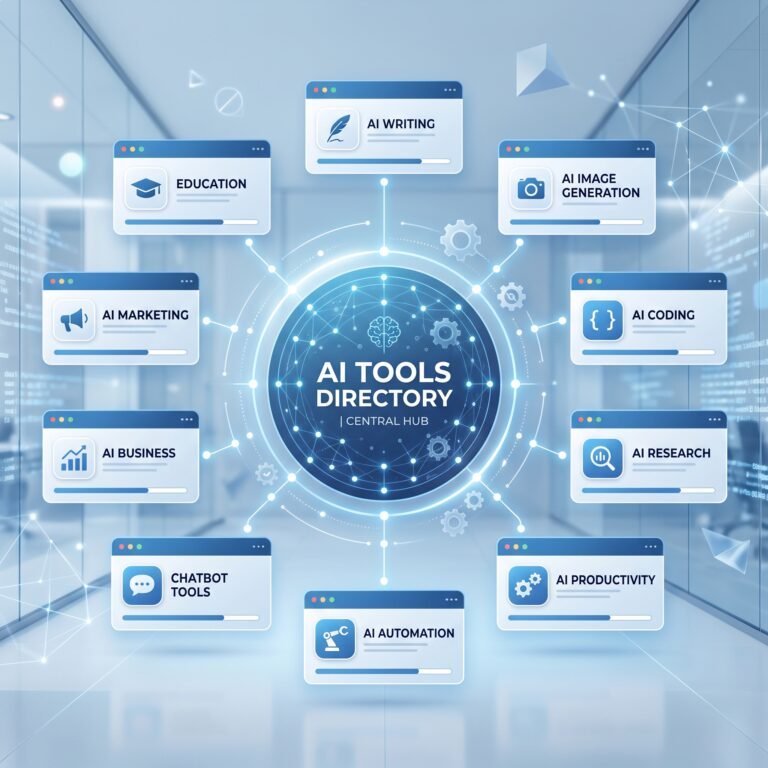
If you are still comparing options, an AI tools directory can be a useful next step.
Instead of searching randomly for software, use a directory to compare tools by:
- Marketing category
- Use case
- Pricing
- AI capabilities
- Audience
- Alternatives
- Integrations
This is particularly useful when you already know the problem you want to solve but have not yet decided which platform deserves a paid subscription.
Rather than building an enormous collection of tools, start with one or two products that address your biggest marketing bottlenecks and expand the stack only when there is a clear reason to do so.
Frequently Asked Questions
What are the best AI tools for marketing in 2026?
The best tools depend on the task. ChatGPT is a strong general-purpose marketing assistant, Semrush is well suited to SEO and AI-search visibility, HubSpot is strong for CRM-driven automation, Jasper focuses on marketing content, Canva supports creative production, and Zapier is useful for connecting automated workflows.
What is the best AI tool for digital marketing?
There is no universal winner. A general AI assistant can support strategy and research, while specialized platforms are usually better for SEO, CRM, advertising or analytics.
Which AI tool is best for SEO?
Semrush is one of the strongest options for marketers who need keyword research, competitor analysis, technical SEO, position tracking and AI-search visibility. Its current plans include capabilities for monitoring AI visibility across several answer engines.
What are the best AI marketing automation tools?
HubSpot is useful for CRM-centered marketing automation, while Zapier is particularly useful for connecting different applications and automating cross-platform workflows.
Can AI replace digital marketers?
AI can automate parts of marketing, but it does not eliminate the need for strategy, judgment, positioning, creativity, relationship building and human oversight. In most organizations, AI works best as an amplifier of human expertise.
Are AI marketing tools worth paying for?
They can be if the tool solves a significant workflow problem. Calculate how much time, labor or additional output the tool can realistically provide and compare that value with its total cost.
What is the best free AI marketing tool?
There is no single best free tool for every task. Free general-purpose AI assistants are useful for research and content ideation, while platforms such as HubSpot and Zapier also provide free entry points for specific marketing and automation workflows.
How is generative AI changing digital marketing?
Generative AI is accelerating content production, creative development, research, personalization and campaign experimentation. Advertising platforms are also integrating AI directly into targeting, bidding and creative workflows.
Can AI automate marketing campaigns?
Yes, parts of a campaign can be automated, including audience segmentation, workflow triggers, content variations, reporting and certain advertising optimizations. However, strategic decisions and high-impact actions should generally retain human oversight.
How do I choose an AI marketing tool?
Start with the marketing problem, then compare required features, integrations, AI capabilities, pricing, scalability, privacy, output quality and potential ROI. Choose the tool that fits your workflow rather than the tool with the longest feature list.
Conclusion
The best AI marketing tools in 2026 are not necessarily the ones with the most impressive AI features. They are the tools that solve real marketing problems.
For SEO, specialized platforms such as Semrush can provide deeper search intelligence. For CRM and automation, HubSpot can connect AI with customer workflows. Jasper and Copy.ai are useful for marketing content and repeatable GTM processes Best AI Marketing Tools, while Canva can accelerate creative production. Best AI Marketing Tools Zapier becomes valuable when different marketing Best AI Marketing Tools applications need to work together.
Meanwhile, AI built directly into advertising platforms Best AI Marketing Tools is becoming increasingly important for campaign optimization and creative production.
The biggest opportunity is therefore not replacing marketers with AI. It is building smarter workflows where AI handles repetitive analysis and production while humans provide strategy, judgment, creativity and quality control.
Before buying anything, identify your biggest marketing bottleneck, test the tools that address it, compare the total cost, and measure whether the software actually improves your workflow.
The right AI marketing stack is not the biggest one. It is the one that creates measurable value with the least unnecessary complexity.