AI Aggregators in 2026 & Best All-in-One AI Platforms
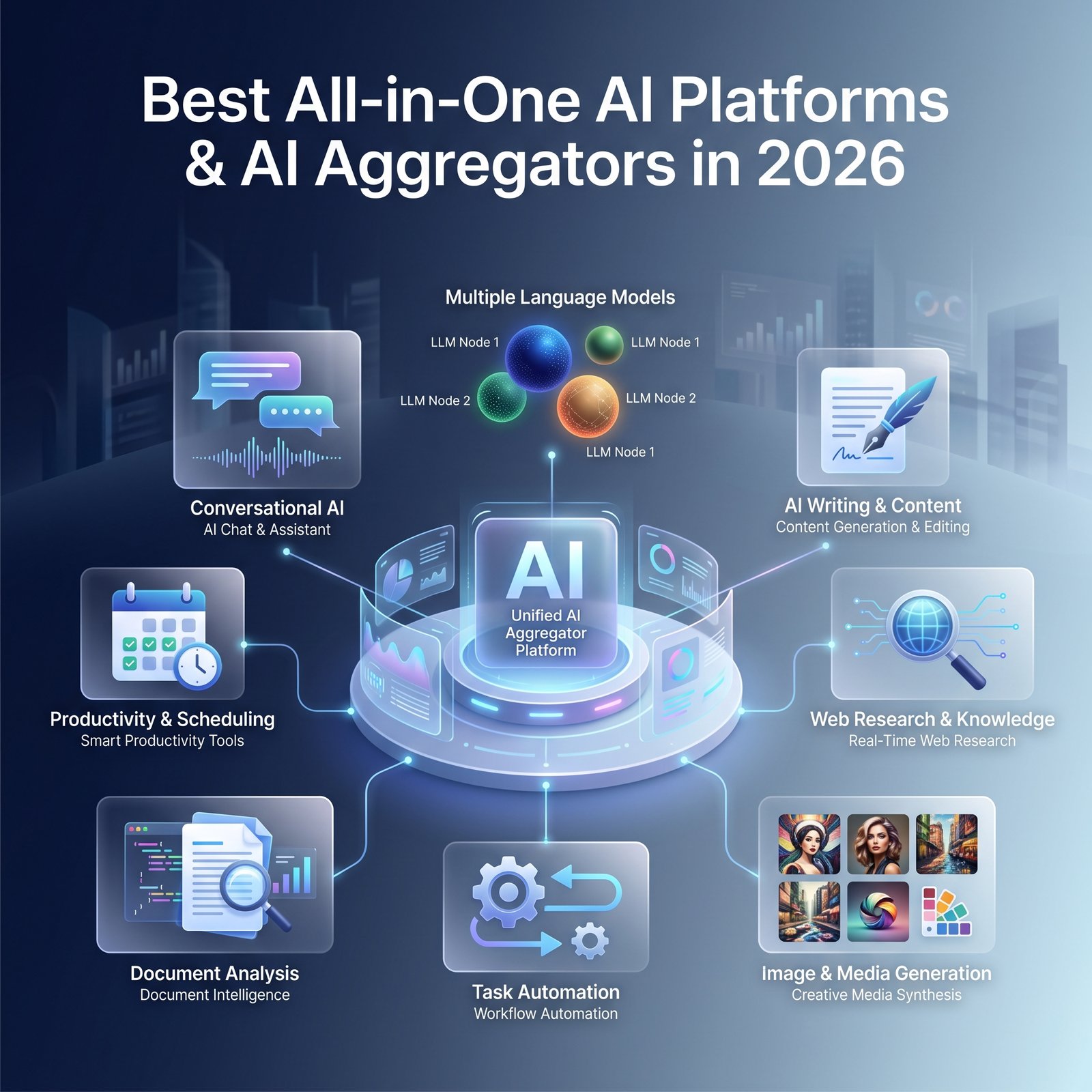
AI Aggregators in 2026 is limited to a single chatbot. In 2026, users can choose from dozens of powerful AI models and specialized tools for writing, research, coding, image generation, automation, and productivity. The challenge is deciding how to access all of them without constantly switching between different websites and subscriptions.
That is where an AI Aggregators in 2026 all-in-one AI platform can be useful.
These platforms bring multiple AI models, tools, or workflows into one place. Some focus on comparing language models, while others combine chat, research, image generation, document analysis, coding, and automation.
An AI Aggregators in 2026 takes this idea a step further by giving users access to multiple AI systems through one interface. Depending on the service, you may be able to compare models, use several models at once, or choose a different model for each task.
There is no single best platform for everyone. Students may prioritize AI Aggregators in 2026 research and affordability, developers may want coding models, while businesses may care more about integrations, automation, and privacy.
This guide explains how these platforms work and compares the leading options available in 2026.
What Is an All-in-One AI Platform?
An AI Aggregators in 2026 all-in-one AI platform is a service that combines several AI capabilities, models, or workflows into one interface.
Instead of using one website for writing, another for research, another for coding, and another for image generation, an all-in-one platform may allow you to perform several of these tasks from the same dashboard.
Depending on the platform, features can include:
- AI chat
- AI Aggregators in 2026
- Multiple AI models
- AI writing tools
- AI Aggregators in 2026
- Web research
- Document analysis
- AI Aggregators in 2026
- AI image generation
- Coding assistance
- AI agents
- AI Aggregators in 2026
- Automation
- Project workspaces
- File uploads
- AI Aggregators in 2026
- Productivity features
- AI Aggregators in 2026
However, the phrase all-in-one AI does not mean every platform offers every feature. Some platforms are primarily multi-model chat services, while others are broader AI workspaces.
For example, OpenRouter focuses heavily on access to many models through one interface and API, while TypingMind acts as an AI frontend that can connect users to multiple providers through their own API keys.
One AI Model vs. AI Platform
A single AI model is the underlying technology that generates responses.
An AI chatbot gives you an interface for interacting with one or more models.
An AI aggregator connects multiple AI models or services.
An AI workspace can go beyond model access by adding projects, files, agents, plugins, research, or automation.
These categories overlap, so one service can technically be both an AI aggregator and an all-in-one AI platform.
What Is an AI Aggregator?
An AI aggregator is a platform that brings multiple AI models, services, or capabilities together.
Instead of subscribing to or opening several individual AI websites, users can access different systems from one location.
For example, a multi-model platform may allow you to choose between models from providers such as OpenAI, Anthropic, Google, xAI, or other developers.
The exact meaning of AI aggregator varies. Some platforms are primarily designed for comparing language models, while others combine text, image, research, coding, and productivity tools.
This is also why searches such as AI aggregators, AI model aggregator, AI chatbot aggregator, and even the misspelled AI-ggregator generally point toward the same broader idea: centralized access to multiple AI systems.
All-in-One AI vs. AI Aggregator: What’s the Difference?
The two concepts overlap, but there is a useful distinction.
| Feature | All-in-One AI Platform | AI Aggregator |
|---|---|---|
| Multiple AI models | Often | Usually |
| Multiple AI tools | Often | Sometimes |
| Writing | Often | Depends |
| Image generation | Depends | Depends |
| Research | Depends | Depends |
| Coding | Depends | Depends |
| Automation | Sometimes | Less common |
| Main purpose | Broad AI workspace | Access to multiple AI systems |
An AI aggregator is generally centered around accessing multiple AI models or services.
An all-in-one AI platform can be broader, combining model access with writing, research, image generation, automation, files, projects, and other tools.
In practice, a platform can be both.
Best All-in-One AI Platforms in 2026
The following platforms are worth considering for different reasons. They should not all be treated as direct competitors because their approaches are different.
1. Poe
Best for: General users who want many AI models and creative tools in one app.
Poe is one of the most recognizable multi-model AI platforms. Its current offering includes models and bots from several providers, along with image, video, and audio capabilities.
Poe’s subscription information currently lists access to models including GPT-5.5, Claude Opus 4.7, Gemini 3.5 Flash, DeepSeek-R1, as well as creative systems such as Veo and Sora.
Strengths
- Large selection of AI models
- Multiple AI providers in one interface
- Text, image, video, and audio capabilities
- Useful for experimenting with different models
- Simple consumer-focused experience
Potential limitation
Usage is based on Poe’s point system, and heavier use generally requires a paid plan.
Poe says its subscriptions provide substantially more messages and access to more advanced models and media-generation bots.
Best for: Students, creators, writers, and everyday AI users who want variety.
2. OpenRouter
Best for: Developers, AI enthusiasts, and users who want extensive model choice.
OpenRouter takes the AI aggregator concept very seriously. Its platform provides access to hundreds of models from many providers through a unified interface and API.
Its current platform advertises 400+ models and 70+ providers, although model availability can change over time.
OpenRouter also provides tools for comparing models, pricing, context windows, capabilities, and providers.
Strengths
- Very large model selection
- Unified API
- Model comparison
- Multiple providers
- Free model options
- Routing capabilities
- Useful for developers
Its current free plan includes 25+ free models and a 50-request-per-day rate limit, while paid usage is based on model pricing.
Potential limitation
OpenRouter is more technical than consumer-first AI chat applications.
Best for: Developers and advanced AI users who want maximum model flexibility.
3. Perplexity
Best for: Research and web-based information discovery.
Perplexity is different from a traditional AI chatbot because search and sourcing are central to its experience.
Its current paid offerings provide access to multiple third-party AI models alongside Perplexity’s own systems. Its documentation states that available models can change as providers release new models.
Perplexity Pro currently provides access to advanced models and deeper research features, while its model selection includes systems from providers such as OpenAI, Anthropic, Google, xAI, and others.
Strengths
- Web-focused research
- Citations and sources
- Multiple AI models
- Deep research
- File and image support
- Useful for reports and information gathering
Potential limitation
It is primarily optimized around research and search rather than being a universal replacement for every specialized AI tool.
Best for: Researchers, students, journalists, marketers, and professionals.
4. TypingMind
Best for: Users who want a customizable AI workspace using their own API keys.
TypingMind works differently from subscription-based AI platforms. It is an AI frontend that lets users connect multiple AI providers.
Its current product supports models from OpenAI, Claude, Gemini, and other providers. It also offers multi-model chats, agents, plugins, projects, folders, document uploads, web search, and other features depending on the license level.
TypingMind currently offers lifetime licenses rather than a conventional recurring software subscription, with API usage paid separately to the relevant providers.
Strengths
- Multiple AI providers
- Multi-model conversations
- Customizable workspace
- Projects and folders
- Plugins and agents
- Bring-your-own-API-key approach
Potential limitation
Users need to understand API keys and usage costs.
Best for: Advanced users who want more control over their AI setup.
5. ChatHub
Best for: Users who want several major AI chatbots in one consumer-friendly interface.
ChatHub currently advertises access to 30+ AI models, including GPT, Gemini, Claude, DeepSeek, and Kimi. Its paid plans also include image generation, document uploads, web access, and simultaneous conversations with multiple chatbots.
One particularly useful feature is the ability to chat with up to six chatbots simultaneously.
Strengths
- Multiple major AI models
- Side-by-side chatbot conversations
- Image generation
- Document uploads
- Web access
- Mobile apps
Potential limitation
Advanced usage is tied to plan quotas.
Best for: People who want an easy way to compare several AI models.
6. Monica
Best for: Users looking for a broad AI workspace covering chat, writing, images, video, research, and agents.
Monica currently combines multiple models and AI capabilities in one platform. Its plans list access to models such as GPT, Claude, and Gemini, along with image and video generation, Deep Research, AI agents, slide creation, browser automation, and integrations.
Its free plan currently provides limited daily access to basic models and trials of selected features.
Strengths
- Multiple AI models
- Writing tools
- Image and video generation
- Research
- AI agents
- Browser automation
- Productivity integrations
Potential limitation
Advanced features and higher usage levels require paid plans.
Best for: Creators, marketers, freelancers, and users wanting a broad AI toolbox.
Best AI Aggregators for Using Multiple AI Models
The biggest reason people search for an AI aggregator is simple: they want choice.
Different models can behave differently when handling the same task. One might be better suited to coding, another to writing, and another to research.
Platforms such as Poe, OpenRouter, Perplexity, TypingMind, and ChatHub provide different approaches to multi-model access.
For example:
- Poe: convenient consumer access to many models and media tools.
- OpenRouter: extensive model and provider selection.
- Perplexity: strong combination of search, research, and model choice.
- TypingMind: customizable multi-provider workspace.
- ChatHub: convenient simultaneous chatbot comparison.
The best option depends on whether you value simplicity, research, technical control, or model variety.
How to Use Multiple AI Models at Once
There are several ways to use multiple AI models at once.
Method 1: Use Separate AI Websites
You can ask the same question in several AI services and compare the answers manually.
This gives you maximum direct access but requires switching between websites.
Method 2: Use an AI Aggregator
A multi-model platform can put several AI systems behind one interface.
This is usually more convenient when you frequently switch between models.
Method 3: Compare Multiple Models
Some services let you send the same prompt to multiple models simultaneously.
ChatHub, for example, advertises simultaneous conversations with up to six chatbots.
Method 4: Use Model Routing
Some advanced platforms can route requests between models.
OpenRouter currently offers an Auto Router that selects models based on the request and configured preferences.
This can be useful when you want model selection to happen automatically rather than choosing manually.
Benefits of Using an All-in-One AI Platform
One Dashboard
You can manage several AI workflows from one place rather than opening multiple websites.
Multiple Models
Different tasks can be assigned to different models.
Easier Comparison
Comparing outputs can help you identify differences in reasoning, writing style, or usefulness.
Simplified Workflow
Research, writing, brainstorming, coding, and other tasks can potentially happen within one environment.
Centralized Projects
Some platforms offer project folders, document storage, knowledge bases, or workspaces.
Potentially Simpler Billing
Instead of maintaining several separate subscriptions, an aggregator may provide access through one subscription or usage system.
However, this does not automatically mean it is cheaper.
Disadvantages of AI Aggregators and All-in-One AI Platforms
All-in-one does not always mean better.
Usage Limits
A platform may restrict the number of advanced-model requests you can make.
Changing Model Availability
Models can be added, removed, renamed, or changed.
Feature Restrictions
Image generation, research, automation, or advanced models may only be available on certain plans.
Privacy Considerations
Your prompts may pass through an intermediary platform rather than directly to the model provider. Review the platform’s data policies before entering confidential information.
Specialized Tools Can Be Better
A platform that offers ten categories of AI tools may not be as strong in every category as a service dedicated to one task.
Best All-in-One AI Platforms for Different Users
| User | What to Prioritize |
|---|---|
| Students | Research, explanations, files, affordable access |
| Writers | Writing quality, editing, context, projects |
| Developers | Coding models, API access, agents |
| Researchers | Web search, citations, model comparison |
| Businesses | Security, collaboration, integrations |
| Content Creators | Writing, images, video, research |
| AI Enthusiasts | Model variety and experimentation |
For example, a student may prefer Perplexity for research, while a developer may find OpenRouter or TypingMind more useful.
All-in-One AI Platforms for Writing, Images, Research, and Coding
AI Writing
All-in-one platforms can help with:
- Blog drafts
- Emails
- Summaries
- Rewriting
- Brainstorming
- Content planning
However, writers should still review AI-generated content for accuracy, originality, tone, and factual claims.
AI Image Generation
Some platforms now include image generation alongside text-based AI.
Monica, Poe, and other platforms offer access to image-generation capabilities, although the available models and usage limits vary by plan.
AI Research
Research-focused platforms can combine web search with language models to find and summarize information.
Perplexity is particularly relevant here because research, citations, and web access are central to its product.
AI Coding
Developers can use multi-model platforms to experiment with different coding models for:
- Code generation
- Debugging
- Refactoring
- Explanations
- Prototyping
OpenRouter is especially relevant for developers because it provides unified access to many models through an API.
AI Automation
Some platforms increasingly include AI agents and automation features.
Monica, for example, currently lists AI agents and browser automation among its advanced features.
Are AI Aggregators Cheaper Than Paying for Multiple AI Tools?
Sometimes, but not always.
An aggregator may reduce subscription complexity because you can access several models through one service.
However, you should compare:
- Monthly subscription cost
- Number of advanced requests
- Model availability
- Image-generation limits
- File limits
- Research features
- API costs
- Speed
- Usage restrictions
A heavy user may discover that a direct subscription provides more generous access to one specific service.
On the other hand, someone who regularly switches between several models may find an aggregator more convenient.
Convenience and flexibility can be just as important as price.
Free All-in-One AI Platforms
Free access varies significantly.
Some platforms are completely free for limited functionality, while others use a free tier to let users test the service before upgrading.
For example, OpenRouter currently lists more than 25 free models on its free plan, with usage limits.
Monica also offers a free plan with limited daily access to basic models and selected feature trials.
Poe provides access to its service without requiring every user to purchase a subscription, but paid plans unlock substantially more usage and advanced access.
Always check the current plan page before describing an AI platform as “free.” Free tier and unlimited free access are very different things.
How to Choose the Best All-in-One AI Platform
Before signing up, ask these questions:
1. Which AI models are included?
Model variety is useful only if the models you actually want are available.
2. How many models can I use?
Some platforms offer dozens or hundreds, while others focus on a smaller selection.
3. Does it support research?
If you need current information, look for web search, citations, and research features.
4. Does it support images?
Creators may want image generation and editing in addition to text.
5. Can I upload files?
Document support is particularly useful for students, researchers, and businesses.
6. Does it support coding?
Developers should look for strong coding models, code execution where available, and development integrations.
7. What are the usage limits?
A low monthly price may not be good value if your usage is heavily restricted.
8. How does it handle data?
Check privacy policies and data-retention options before using confidential information.
9. Is it easy to use?
The biggest collection of AI tools is not useful if the interface is confusing.
What to Look for in AI Hub Tools
The best AI hub tools should make AI easier to manage, not simply put a large number of models on one screen.
Look for:
- Multiple models
- Model switching
- File support
- Centralized projects
- AI agents
- Integrations
- Automation
- Transparent pricing
- Privacy controls
- Good search and organization
A smaller platform with a clean workflow can be more useful than a huge platform filled with tools you never use.
AI Aggregator vs. Individual AI Subscriptions
| AI Aggregator | Individual AI Services |
|---|---|
| One interface | Direct provider interface |
| Multiple models | Usually provider-specific |
| Easier comparison | Specialized experience |
| Potentially simpler billing | Separate subscriptions |
| Centralized workflow | Direct ecosystem access |
| May have usage limits | May offer higher direct limits |
| Features depend on aggregator | Full provider feature set |
An aggregator is attractive when variety matters.
An individual subscription may be better when you already know which AI service fits your workflow.
Are All-in-One AI Platforms Worth It in 2026?
For many users, yes—but only when they actually need multiple AI capabilities.
An all-in-one AI platform can be particularly useful if you regularly:
- Compare AI models
- Research online
- Write content
- Analyze documents
- Generate images
- Code
- Experiment with AI agents
- Manage multiple projects
It may be unnecessary if you only use one AI assistant for occasional questions.
The important question is not:
“Which platform has the most AI tools?”
Instead, ask:
“Which platform gives me the tools and models I actually need?”
That approach usually leads to a better decision.
Final Comparison of All-in-One AI Platforms
| Platform | Multiple Models | Writing | Images | Research | Coding | Free Option | Best For |
|---|---|---|---|---|---|---|---|
| Poe | Yes | Yes | Yes | Limited | Yes | Limited | General users |
| OpenRouter | Yes | Yes | Yes | Depends | Yes | Yes | Developers |
| Perplexity | Yes | Yes | Yes | Yes | Limited | Yes | Research |
| TypingMind | Yes | Yes | Yes | Yes | Yes | License-based | Advanced users |
| ChatHub | Yes | Yes | Yes | Yes | Yes | Limited | Model comparison |
| Monica | Yes | Yes | Yes | Yes | Yes | Yes | All-in-one workflows |
Feature availability and usage limits can vary by plan and can change as providers update their models. For example, Perplexity explicitly notes that its model lineup can change over time, while OpenRouter’s model catalog is continually updated.
Frequently Asked Questions
What is an all-in-one AI platform?
An all-in-one AI platform combines multiple AI models, tools, or workflows in one interface. Depending on the service, it may include chat, writing, research, images, coding, files, and automation.
What is an AI aggregator?
An AI aggregator brings multiple AI models or services together through one platform, allowing users to access or compare different AI systems without switching between separate websites.
What are the best AI aggregators in 2026?
Strong options include Poe, OpenRouter, Perplexity, TypingMind, and ChatHub. The right choice depends on whether you prioritize research, model variety, technical control, or ease of use.
Can I use multiple AI models at once?
Yes. Some platforms allow simultaneous model conversations or multi-model workflows. ChatHub supports conversations with multiple chatbots simultaneously, while Perplexity’s Model Council can query three AI models simultaneously and synthesize their results on eligible plans.
What is the best all-in-one AI platform?
There is no universal winner. Poe is convenient for broad model access, OpenRouter is strong for developers, Perplexity is research-focused, and TypingMind is useful for customizable multi-provider workflows.
Are AI aggregators free?
Some offer free tiers or free models, but most advanced usage has limits or requires payment. OpenRouter, for example, currently offers free models with usage restrictions.
Are AI aggregators worth it?
They can be worthwhile if you use several AI models regularly. If you only need one specific AI service, a direct subscription may be simpler.
Can an AI aggregator replace ChatGPT?
It can replace some of the reasons you use ChatGPT, particularly if you mainly want access to multiple models. However, individual AI providers may offer features that an aggregator does not fully reproduce.
What are AI hub tools?
AI hub tools are platforms that centralize multiple AI models or capabilities. They can function as AI aggregators, AI workspaces, or broader productivity platforms.
Can I use multiple AI models without paying for several subscriptions?
Yes, depending on the platform. Some services provide multiple models through one subscription, while others use API-based or usage-based pricing. Always compare limits and included models.
Which all-in-one AI platform is best for students?
Students should prioritize affordability, research, citations, document support, and learning features. A research-oriented platform such as Perplexity may be especially useful, while multi-model platforms can provide more flexibility.
Which AI aggregator is best for business?
Businesses should evaluate security, privacy, collaboration, integrations, administration, and usage controls rather than simply choosing the platform with the most models.
Which AI platform is best for writing and research?
A research-oriented platform can be useful when current sources and citations matter, while a general multi-model platform may provide more flexibility for writing and editing. The best choice depends on the workflow.
Conclusion
The rise of the all-in-one AI platform is changing how people use artificial intelligence. Instead of relying on one model for every task, users can increasingly choose from multiple models and specialized capabilities through centralized platforms.
An AI aggregator can be particularly useful for people who want to compare models, experiment with different systems, or avoid constantly switching between AI websites.
For developers, OpenRouter provides extensive model access and API flexibility. For research, Perplexity combines web search with multiple AI models. Poe offers a broad consumer-friendly collection of models and creative tools, while TypingMind gives advanced users a customizable multi-provider workspace. ChatHub focuses heavily on comparing multiple chatbots, and Monica combines models with a broader set of AI productivity and creative capabilities.
The most important thing is not choosing the platform with the longest feature list. Choose the one that matches your actual workflow, budget, preferred models, privacy requirements, and daily tasks.